Why the Back of My Heel Hurts Going Up Stairs: Tendonitis vs. Bursitis
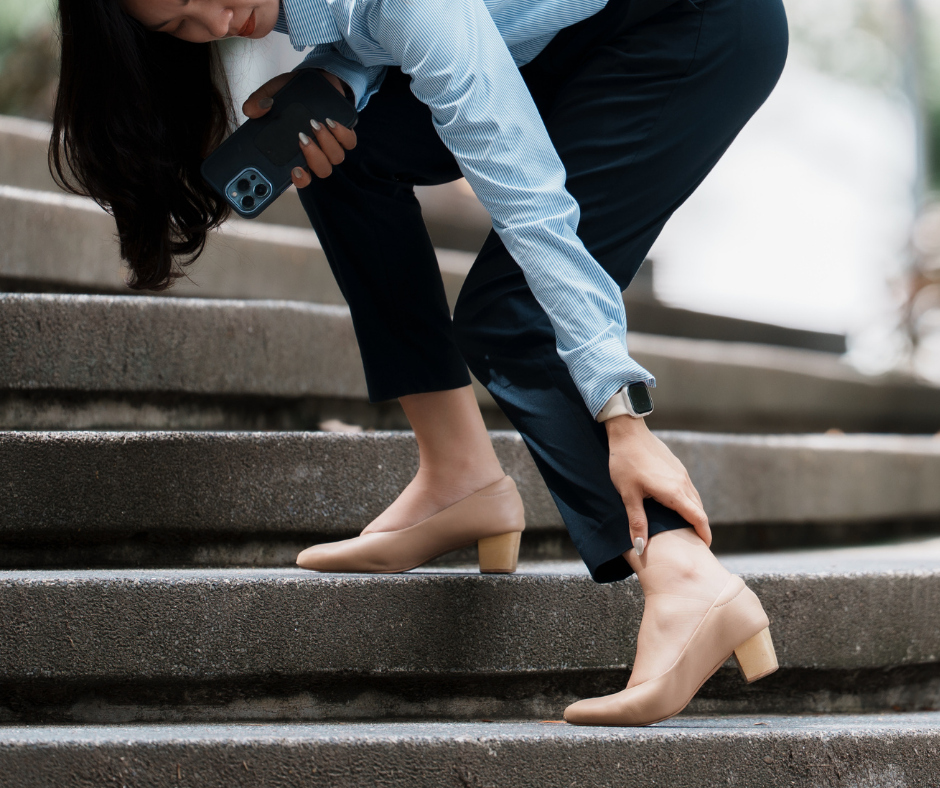
Notice a sharp, localized pain when climbing the steps in your home or office? While bottom-of-the-foot pain is usually plantar fasciitis, pain at the back of the heel requires a completely different diagnostic approach. If you find yourself searching, "why does the back of my heel hurt going up stairs," you are likely dealing with one of two distinct inflammatory conditions: Achilles tendonitis or retrocalcaneal bursitis.
At PodiatryCare, P.C. and the Heel Pain Center, we specialize in identifying the exact structural cause of rearfoot pain. Here is how to tell which condition is making your daily stair climb so unpleasant.
The Biomechanics of the Stair Climb
To understand why stairs trigger such intense pain, you have to look at the mechanics of ankle dorsiflexion.
· When you plant your foot on a step and push your body weight upward, your ankle bends deeply, bringing your toes closer to your shin.
· This angle places massive mechanical tension on the back of your heel, forcefully stretching the soft tissues and compressing them against the rigid heel bone (calcaneus).
· If those tissues are already irritated, the "pinch" of climbing a stair causes an immediate, shooting pain.
The Achilles tendon is the thickest, strongest tendon in the human body, connecting your calf muscles to the back of your heel bone. "Insertional" Achilles tendonitis occurs at the exact point where this fibrous cord attaches to the bone.
Key Symptoms of Insertional Achilles Tendonitis:
Direct Tendon Pain: The pain is located on the thick cord at the back of your ankle.
Morning Stiffness: The tendon feels incredibly rigid and tight when you first wake up, making it difficult to walk normally.
Activity Triggers: While it often plagues runners, there are several hidden causes of Achilles tendonitis that aren't running, like sudden increases in walking distance or climbing ladders. Because foot mechanics vary, we see distinct differences when comparing Achilles tendonitis in different types of athletes versus everyday walkers.
Retrocalcaneal Bursitis: The Swollen Cushion
Unlike a fibrous tendon, a bursa is a small, fluid-filled sac designed to act as a lubricating cushion between a bone and a tendon.
· The retrocalcaneal bursa sits perfectly wedged between your Achilles tendon and your heel bone.
· When subjected to excessive friction, this sac becomes inflamed, engorged with fluid, and intensely painful.
Key Symptoms of Retrocalcaneal Bursitis:
The "Pump Bump": You will often notice a visible, red, swollen bump directly on the back of the heel bone (frequently referred to as Haglund’s deformity).
Spongy Swelling: If you press on the back of your heel, the area feels soft and spongy rather than fibrous and tight.
Shoe Friction: The condition is highly aggravated by the stiff backs of dress shoes or boots pressing against the inflamed sac. This is why it is critical to evaluate how your new shoes fit (and whether or not you should return them) before the stiff heel counter causes permanent irritation.
The Dual Diagnosis
Because the bursa sac and the Achilles tendon are situated right next to each other, it is incredibly common to suffer from both conditions simultaneously.
· As the inflamed bursa swells, it pushes against the Achilles tendon, and as the Achilles tendon tightens, it grinds against the bursa.
· Breaking this cycle of inflammation requires precision care. Stretching an inflamed tendon might feel good, but forcefully stretching an inflamed bursa can make the swelling much worse.
Get Back to Pain-Free Movement
You do not have to modify your life to avoid the stairs!
Our clinic offers advanced diagnostics to pinpoint the exact location of your inflammation and provides comprehensive tendon and heel pain treatments, ranging from customized orthotic scaffolding to targeted regenerative therapies. Come discover how simple recovery can be.
At PodiatryCare, PC, and the Heel Pain Center, we care for a wide variety of foot and ankle ailments. Dr. Matthew Tschudy, Dr. Rebecca Wiesner, Dr. Kristen Winters, Dr. Laura Vander Poel, and the rest of our team are ready to serve our Hartford County patients. To schedule an appointment at our Enfield location, call (860) 741-3041; for an appointment at our South Windsor location, call (860) 644-6525.